


Large diameter seamless steel pipe means outside diameter more than 100MM and the wall thickness is greater 0.2 than the outer diameter of the pipe, Large-diameter seamless steel tube is made from solid tube ingot or the perforation capillary, then through hot rolling and cold rolling or cold dial. This article will introduce large-diameter seamless steel pipes from the perspectives of their specifications, characteristics, production methods, and applications.
The following table is a common specification table of large-diameter seamless steel pipes for reference:
|
Specification |
Outer diameter(mm) |
Wall thickness(mm) |
|
219×36 |
219 |
36 |
|
219×48 |
219 |
48 |
|
273×36 |
273 |
36 |
|
273×48 |
273 |
48 |
|
325×36 |
325 |
36 |
|
325×48 |
325 |
48 |
|
377×36 |
377 |
36 |
|
377×48 |
377 |
48 |
|
426×36 |
426 |
36 |
|
426×48 |
426 |
48 |
|
529×20 |
529 |
20 |
|
529×24 |
529 |
24 |
|
630×20 |
630 |
20 |
|
630×24 |
630 |
24 |
|
720×20 |
720 |
20 |
|
720×24 |
720 |
24 |
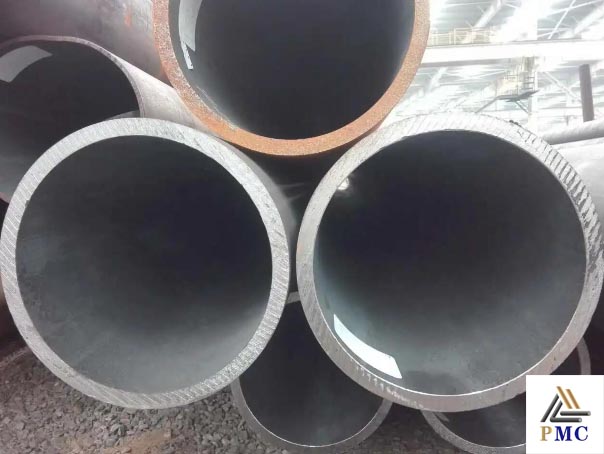
Large-diameter seamless steel pipes have high strength and toughness. Its strength allows it to withstand greater pressure and weight, making it excellent in some structures that need to withstand heavy loads. For example, in the supporting structure of large buildings, large-diameter seamless steel pipes can serve as the main load-bearing components to ensure the stability and safety of the building. At the same time, its good toughness makes it less prone to breakage when subjected to external impact, and it can absorb a certain amount of energy, ensuring the reliability of the pipe in complex environments.
Due to the characteristics of the manufacturing process, large-diameter seamless steel pipes have high dimensional accuracy. Its outer diameter, wall thickness and other dimensions can be strictly controlled within a certain tolerance range, which makes it more convenient and accurate in installation and use. In some projects with strict requirements for pipe dimensions, such as petrochemical pipeline systems, high-precision large-diameter seamless steel pipes can ensure tight pipe connections, reduce the risk of leakage, and improve the overall system operating efficiency.
Large-diameter seamless steel pipes typically have a smooth surface, free from obvious cracks, sand holes, and other defects. This excellent surface quality is not only aesthetically pleasing but also helps reduce resistance to fluid flow within the pipe. During the transportation of liquids or gases, the smooth inner wall reduces energy loss and improves transport efficiency. Simultaneously, it reduces the adhesion of dirt and impurities, extending the pipe's service life.
Through special treatment and material selection, large-diameter seamless steel pipes possess strong corrosion resistance. In harsh environments, such as marine environments and chemically corrosive environments, they can resist the erosion of various chemicals, maintaining the stability of the pipe's performance. For example, in the construction of offshore platforms, large-diameter seamless steel pipes serve as supporting structures and transportation pipelines, requiring long-term exposure to seawater; corrosion resistance is one of the key factors for their normal operation.
Continuously cast round billets or forged and rolled billets are used, with carbon content controlled at 0.1%-0.25% (ASTM A106 standard), and diameter range φ200-600mm. The billet must undergo ultrasonic testing (sensitivity ≥ φ2mm flat bottom hole) and surface grinding to ensure that there are no defects such as cracks and inclusions.
Hot rolling (mainstream process): The billet is heated to 1200-1280℃ (medium carbon steel) and formed into a hollow tube by passing it through a skew rolling piercing mill (such as a Mannesmann piercing mill). The wall thickness deviation is controlled within ±5%.
Extrusion method (suitable for extra-large diameter): Using a vertical extruder (pressure ≥100MN), heated billets are extruded into tubes, suitable for specifications of φ1000mm and above, but the cost is relatively high.
1. In the construction industry, large-diameter seamless steel pipes are commonly used in large-span buildings such as stadiums, serving as core load-bearing components for beams and columns. They can also be applied to curtain wall structures, balancing stability and aesthetics. Furthermore, these pipes are widely used in the water supply and drainage systems of high-rise buildings, ensuring a stable supply of water and wastewater.
2. The petrochemical industry has stringent standards for pipelines. Large-diameter seamless steel pipes are characterized by high strength, corrosion resistance, and excellent dimensional accuracy. They are suitable for high-pressure geological environments and are widely used in oil well casing pipe , production tubing, and the transportation of oil and corrosive chemical media, ensuring safe and stable production.
3. In mechanical manufacturing, large-diameter seamless steel pipes are used to manufacture various mechanical parts and equipment. For example, as shaft parts, they possess high strength and rigidity, ensuring the normal operation of machinery. In hydraulic systems, large-diameter seamless steel pipes serve as pipelines to transport hydraulic oil and transmit power; their excellent sealing and pressure resistance are crucial for the stable operation of the hydraulic system.
4. Large-diameter seamless steel pipes are also widely used in the transportation sector. It can be used to manufacture railway bridge supports and track fixing components to ensure traffic safety; it is also used in key components such as automobile frames and drive shafts to improve overall vehicle performance. Furthermore, it is widely used in ship structures and pipeline systems to ensure stable and reliable navigation.
Q1: What is the definition of a large-diameter seamless steel pipe?
A1: A large-diameter seamless steel pipe refers to a steel pipe with an outer diameter greater than 100mm and a wall thickness greater than 0.2 times the outer diameter. It is made from solid steel ingots or perforated capillary tubes through hot rolling, cold rolling, and other processes, and has no welded joints.
Q2: What is the specification range of large-diameter seamless steel pipes, and what are the two categories they can be divided into?
A2: Their outer diameter is typically between 89mm and 1200mm, and their wall thickness is between 5mm and 200mm. Based on wall thickness, they can be divided into large-diameter thick-walled seamless steel pipes and large-diameter thin-walled seamless steel pipes.
Q3: What are the core characteristics of large-diameter seamless steel pipes?
A3: There are four core characteristics: excellent mechanical properties, high dimensional accuracy, good surface quality, and high corrosion resistance, which can meet the stringent requirements of various fields.
Q4: What are the raw materials and main processes for producing large-diameter seamless steel pipes?
A4: The raw materials are solid steel ingots or perforated capillary tubes. The main production processes include hot rolling and cold rolling, which process the raw materials into seamless hollow steel pipes.
Q5: In which fields are large-diameter seamless steel pipes mainly used?
A5: It is mainly used in four major fields: construction, petrochemical, machinery manufacturing and transportation, and is adapted to the structural support, media transportation and other needs of different scenarios.
