How smooth can the inner surface finish of a cold drawn seamless steel tube be? It depends mainly on the customer's product requirements. In hydraulic tube applications, the inner surface finish of cold drawn seamless tube can reach as tight as Rz2.0mm/M — a level of precision that's difficult for many manufacturers to achieve consistently, but Permanent Steel Manufacturing Co., Ltd (PMC) can.
So what actually affects the inner surface finish of a cold drawn seamless tube? Several factors in the manufacturing process determine how fine that finish turns out.
1. The Main Influencing Factors of the Inner Surface Finish of Cold Drawn Seamless Steel Tube
1.1 Piercing
Inconsistent piercing temperature and outdated equipment are common causes of uneven heating in the round steel billet during the cold drawn tube piercing process. This creates a temperature gap between the inside and outside of the tube, which shows up later as pitting, pockmarks, or surface peeling — all of which affect inner surface finish. An extended perforation furnace with even heat distribution across the billet helps avoid this problem.
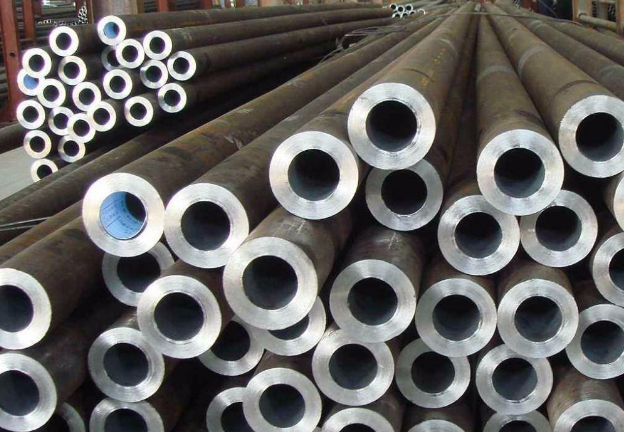
1.2 Cold Drawn Mold
Defects in the drawing die itself carry straight through to the finished tube's internal surface. Cold drawing die precision is one of the most direct levers over the result: dies that are worn, poorly machined, or not matched to the specific tube dimensions will produce a rougher inner bore regardless of how well the rest of the process is controlled.
1.3 Pickling
Because of tightening environmental regulations, many manufacturers have moved pickling to third-party processors without the accumulated process data to get it right — pickling time varies by steel grade, and without that data, the result is either incomplete removal of internal scale and impurities or over-pickling that creates pitting. An in-house, environmentally enclosed pickling process for steel tube, backed by grade-specific time data, is what keeps this step consistent.
1.4 Number of Drawing Passes
The number of drawing passes has a direct effect on tube finish: smaller deformation per pass generally produces a smoother inner surface finish, but it also adds cost, since more passes are needed to reach final dimensions. Reducing the number of passes to cut cost is a common shortcut, but it typically comes at the expense of finish quality.
2. Improving Inner Surface Finish Beyond Process Control
Drawing alone often can't reach the tightest specifications on its own. When that's the case, manufacturers typically follow up with honing — passing a tool through the bore to remove the residual peaks left by drawing. High-pressure hydraulic cylinder tube is the most common example, since its finish requirement is usually tighter than a drawn-only process can deliver.
3. FAQs
Q: What inner surface finish can be achieved for cold drawn seamless steel tube?
It depends on the application and what the customer specifies. General-purpose tube typically doesn't require a tightly controlled inner surface finish, while hydraulic tube inner bore finish requirements often call for something in the range of Rz2.0mm/M — expressed using roughness parameters such as Ra or Rz. Buyers should specify the required finish upfront, since it affects process choices like drawing pass count and cost.
Q: Can inner surface finish be checked without cutting the tube open?
Not precisely. Visual or borescope inspection can catch obvious pitting or scale on accessible sections, but an accurate roughness reading (Rz or Ra) requires a profilometer on a cut sample, or specialized bore-scanning equipment for full-length verification. For critical applications, ask the supplier for test data on the specific batch rather than relying on visual checks alone.
Q: Why does inner surface finish matter for hydraulic tube specifically?
A rough inner bore increases friction and turbulence in the oil flow, accelerates seal and piston wear, and can introduce contamination from loose scale or pitting. In hydraulic systems running at high pressure and speed, these effects compound quickly, which is why the finish tolerance is tighter than for general structural or mechanical tube.
4. Conclusion
Inner surface finish isn't the result of any single step — it's the cumulative effect of piercing consistency, die quality, pickling control, and how many drawing passes the tube goes through. A weakness in any one of these will show up in the bore, regardless of how well the others are controlled.
Buyers specifying a tight inner surface finish should ask suppliers directly about their piercing equipment, die sourcing, pickling process, and pass schedule, rather than assuming compliance with a standard automatically covers it. For a broader look at how to verify tube quality before acceptance, see our guide on
How to Identify the Quality of Cold Drawn Seamless Steel Tubes.
Inner surface finish is just one piece of the broader production picture. For a full rundown of how piercing, drawing, and heat treatment fit together, see our guide to the Manufacturing Process of Cold Drawn Steel Tube. Many of the same root causes covered here — die wear, inconsistent pickling — also turn up in our breakdown of What Causes Cold Drawn Seamless Tubes to Crack, and are covered in more depth in our guide to production quality control points.
Related articles:
Common Defects and Causes of Cold Drawn Seamless Steel Tubes
Cold Drawn Seamless Steel Tube Defects: Repair or Reject?