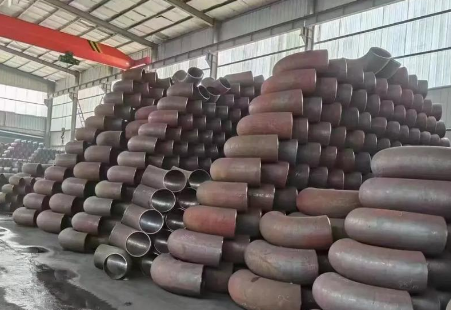
45-degree welded elbows are common connecting components in piping systems, mainly used to change the direction of pipelines or divert fluid flow. The selection of their model parameters directly affects installation efficiency and system stability. The following analyzes their core parameters and characteristics from multiple dimensions and compares them with other types of pipe elbows.
1. Angle and Turning Characteristics
The design angle of a 45-degree welded elbow is fixed at 45 degrees, falling between a 90-degree elbow and a straight pipe. Compared to a 90-degree elbow, it has lower fluid resistance and reduces pressure loss by approximately 30%-40%, making it suitable for applications requiring gentle turns. For example, in chemical pipelines, 45-degree elbows reduce the impact of turbulence on the pipe wall, extending service life. However, for sharp turns, 90-degree elbows still offer greater space advantages.
2. Diameter Specifications (DN)
Common nominal diameter ranges from DN15 to DN1200, corresponding to different wall thickness standards. Taking DN100 as an example, the national standard GB/T12459 specifies an outer diameter of 114.3mm, with wall thickness varying from Sch10 to Sch160 grades. Compared to threaded elbows, welded structures can withstand higher pressures (typically ≥2.5MPa), but require beveling to match the pipe material.
3. Material Classification
Mainly classified into carbon steel (Q235B, 20#), stainless steel (304, 316L), and alloy steel.
Carbon steel elbows have lower costs (approximately 50-200 RMB/piece, depending on specifications) and can withstand temperatures up to 300℃; stainless steel elbows have strong corrosion resistance, and their unit price is 3-5 times that of carbon steel. Compared to injection-molded elbows, welded metal elbows are more suitable for high-temperature and high-pressure environments.
4. Radius of Curvature (R)
Divided into short radius (R=1.0D) and long radius (R=1.5D). Short radius elbows save space but result in more pronounced localized stress concentration; long radius elbows offer superior flow performance and are suitable for conveying granular media. For example, in powder conveying systems, long radius elbows can reduce the risk of material sedimentation.
5. End Treatment Types
Two types are available: flat (PE) and beveled (BE). The bevel design must match the pipe welding bevel angle (commonly 30°±2°) and require argon arc welding or electric arc welding. Compared to flanged elbows, welded elbows offer better sealing, but disassembly and maintenance are more difficult.
6. Differences in Standards
Domestically, GB/T12459 is mainly used, while the internationally accepted standard is ASME B16.9. The wall thickness tolerance for ASME elbows is stricter (±12.5%), while the national standard allows ±15%. Special attention needs to be paid to standard conversion issues in export projects.
7. Pressure Rating Marking
Pressure capacity is indicated by Sch (Schedule Number) or PN. For example, a
Sch40 carbon steel elbow can withstand approximately 3 MPa of pressure at room temperature, while a PVC elbow can only withstand 0.6 MPa under the same conditions. For high-pressure systems, forged or thick-walled welded elbows are used in diverse applications.
8. Manufacturing Process Comparison
Hot-formed elbows have a smoother inner wall, but the cost is about 20% higher than cold-bending elbows; stamped welded elbows are suitable for large-diameter mass production, but the weld seam requires X-ray inspection.
9. Installation Precautions
Before welding, oil stains on the bevel must be removed, and the misalignment should be less than 1.5 mm. Compared with press-fit elbows, welded connections do not require special tools, but require higher operator skill.
10. Application Scenarios
- Oil pipelines: Long-radius alloy steel elbows are preferred.
- Building water supply and drainage: Short-radius carbon steel elbows are more economical.
- Food industry: Diversified use of polished stainless steel elbows.
Conclusion:
The parameter selection for 45-degree welded elbows requires comprehensive consideration of media characteristics, pressure rating, and space constraints. Its advantages lie in its high structural strength and reliable sealing, while its disadvantage is that it requires a high level of professional expertise for installation. In actual engineering projects, performance and cost must be balanced according to specific needs.
Read more: Introduction of 316 Stainless Steel Elbows