


304 stainless steel pipe hardness depends mainly on the material condition. Annealed ASTM A312 TP304 pipe is limited to a maximum of 192 HBW (Brinell) and 90 HRB (Rockwell B). Actual hardness varies with heat treatment, cold working and the manufacturing process, and cold-worked material can be harder than annealed pipe. The hardness of 304 stainless steel pipe is commonly measured with the Brinell, Rockwell and Vickers methods described below.
|
Hardness Type |
Reference Value (Specified Limit) |
Description |
|
Rockwell Hardness |
90 HRB max. |
Maximum allowable Rockwell B hardness for annealed ASTM A312 TP304 pipe. |
|
Brinell Hardness |
192 HBW max. |
Maximum allowable Brinell hardness for annealed ASTM A312 TP304 pipe. |
|
Vickers Hardness |
No fixed value |
Depends on material condition and test conditions. Not given as a fixed limit here. |
These limits apply to annealed ASTM A312 TP304 pipe as specified in the standard. They are maximum allowable values, not typical or measured values, and they do not represent the actual hardness of every 304 stainless steel pipe. HRB and HBW are separate scales, each specified in the standard on its own, so do not treat them as equal or convert one into the other. Always confirm the required value against the purchase specification and the mill test certificate.
Brinell and Rockwell are the two methods most often specified for stainless steel pipe, while Vickers is rarely specified.
Brinell hardness is expressed from the diameter of the indentation, which makes it intuitive and convenient. It is not suitable for harder or thinner steel pipe.
Rockwell testing is also an indentation method, but it measures the depth of the indentation instead of its diameter. It is widely used in steel pipe standards and can be applied to metals from very soft to very hard, which covers the cases where Brinell is not suitable. The value is read directly from the dial. Because the indentation is small, the result reflects a smaller area of the pipe than Brinell and may be less representative of coarse or uneven material.
Vickers testing is also an indentation method. It can be used for thin metal materials and surface-layer hardness. It combines the main advantages of the Brinell and Rockwell methods and overcomes their basic shortcomings, but it is less convenient than Rockwell, so it is rarely used in steel pipe standards.
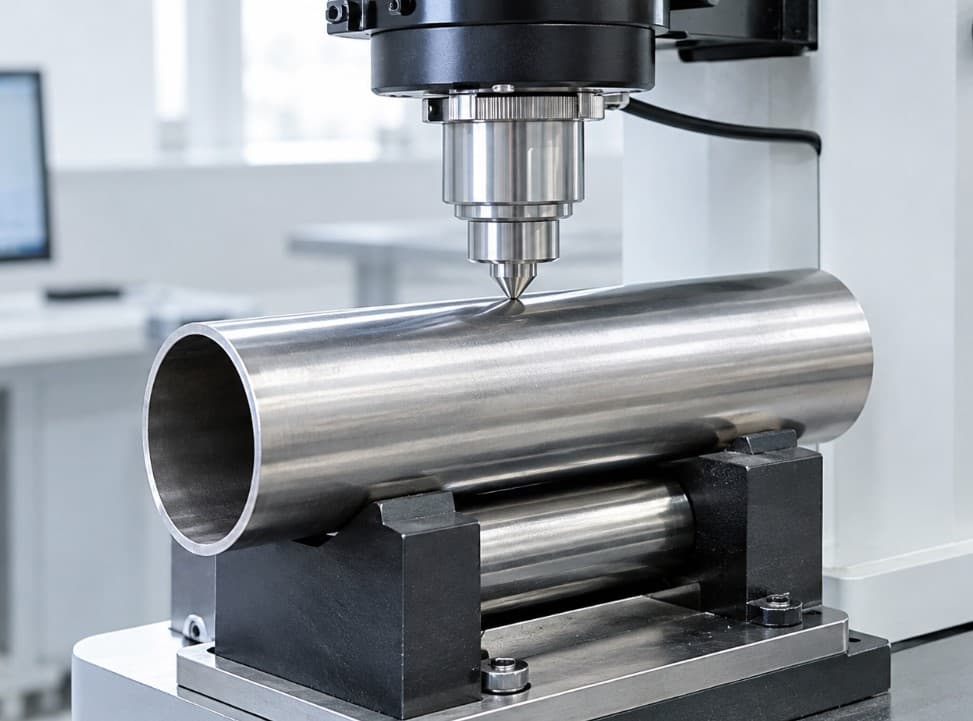
The test method depends on the pipe’s inside diameter and wall thickness:
Inside diameter above 6.0 mm, wall thickness below 13 mm (annealed pipe): the W-B75 Webster hardness tester is fast and easy to use, and is suitable for quick, non-destructive acceptance checks.
Inside diameter above 30 mm, wall thickness above 1.2 mm: use a Rockwell hardness tester to test HRB or HRC.
Inside diameter above 30 mm, wall thickness below 1.2 mm: use a surface Rockwell hardness tester to test HRT or HRN.
Inside diameter between 4.8 mm and 30 mm: use a special Rockwell pipe hardness tester to test HR15T.
Inside diameter above 26 mm: Rockwell or surface Rockwell testing can also be used on the inner wall of the pipe.
Related articles:
Thermal Conductivity of 304 Stainless Steel Pipes
