


Slotted pipe is one of the most common downhole and drainage components used in water well, oil and gas, and civil engineering projects — the question below covers what it is in short, and the section that follows goes into how it's made and specified.
A slotted pipe is a steel pipe with narrow slits cut into its wall. The slits allow water, oil or gas to flow into the pipe while blocking larger particles such as sand and soil. Slotted pipe is most commonly used in water wells, oil and gas wells, and groundwater monitoring, where it works as a filter and drainage screen.
Slotted pipe is typically made by cutting oil casing pipe or tubing with a thin cutting blade or beam-cutting process, producing longitudinal or spiral slits with a width of 0.2–0.5 mm and an open area of 0.5%–10%, depending on the design.
Slotted pipe is valued for its large flow area, consistent slot quality and mechanical strength. The seams are cut with good verticality and a smooth, burr-free edge, so the slit width stays even along the length of the pipe. Slots can be arranged straight or staggered depending on application requirements.
On a 2⅞" screen tube, for example, roughly 300 slits per 1.5 m give a flow area about 2.4 times larger than an unslotted oil pipe of the same size — a key reason slotted pipe performs well in sand-control and filtration duties. The pipe body is usually made from J55 or N80 casing, which provides the strength needed to resist deformation downhole, and a large inner diameter that simplifies pipe string configuration.
|
Parameter |
Typical Information |
|
Slot Width |
0.2–0.5 mm |
|
Slot Shape |
Rectangular, trapezoidal (3–8° angle), and round-hole/special shapes |
|
Open Area |
0.5%–10% |
|
Common Grades |
J55, N80 |
|
Slot Arrangement |
Straight or staggered |
|
Flow Area (2⅞" example) |
~300 slits/1.5 m — about 2.4× a same-size unslotted pipe |
|
Recommended Sand Control |
Suitable for sand particle sizes above 0.3 mm |
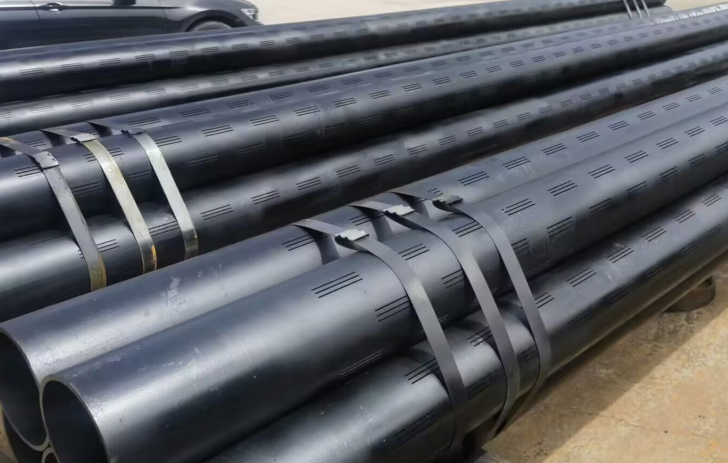
Water Well Construction — Groundwater enters the pipe through the slots while larger soil and sand particles are held back at the pipe wall. This supports stable water collection and filtration, and slotted pipe is widely used in agricultural irrigation, industrial water supply and municipal water systems.
Groundwater Extraction — Slotted pipe forms the filter section of a water well screen. With the slot size and layout matched to the formation, it helps deliver cleaner water and a more stable flow rate from the aquifer.
Oil and Gas Exploration — In production and exploration wells, slotted pipe helps control the entry of formation sand and cuttings while allowing oil or gas to flow into the wellbore, supporting formation sampling, well testing and sand management.
Geological Exploration and Groundwater Monitoring — Installed in monitoring boreholes, slotted pipe allows soil, rock and water samples to be drawn for tracking groundwater levels, water quality and hydrodynamic conditions over time.
Underground Engineering and Soil Protection — As part of drainage systems, slotted pipe helps regulate groundwater levels and reduce the risk of soil liquefaction or slope instability, supporting the overall stability of the project.
Environmental Governance and Wastewater Treatment — Slotted pipe is used to separate sediment from lakes, rivers and other water bodies, and in solid-liquid separation and filtration steps at municipal wastewater treatment plants.
Requirements vary by field, so pipe material, slit size, slot shape and corrosion protection should be matched to the specific application and relevant industry standards, with attention to safe installation practices on site.
Selecting the right slotted pipe generally comes down to four factors:
Pipe diameter — sized to the wellbore or casing string it will run in.
Slot width — set narrow enough to hold back the target particle size.
Open area — balances flow rate against structural strength; higher open area increases flow but can reduce strength.
Pipe material and grade — such as J55 or N80, chosen based on downhole pressure, load and corrosion conditions.
Slot size and open area should be selected according to the formation type, particle size distribution and the flow rate required for the well or system.
Slotted pipe is mainly used as a filter and drainage screen in water wells, oil and gas wells, and groundwater monitoring boreholes. It lets fluid flow through the slits while holding back sand and soil particles, and it is also used in drainage and sediment-control applications in environmental and civil engineering projects.
Slotted pipe refers specifically to pipe with machine-cut slits in its wall, usually made from casing or tubing. "Screen pipe" is a broader term that also covers wire-wrapped and other screen designs. Slotted pipe is one common type of screen pipe, generally chosen for its strength and straightforward manufacturing.
Slot size should be based on the particle size of the surrounding sand or formation material, so that larger particles are retained while fluid flows through freely. Finer formations need narrower slots, while coarser formations allow a wider slot width and higher open area for better flow.
