


Most of the 304 stainless steel cracking cases we see on our own forming lines trace back to a handful of avoidable causes, not to the material itself. This guide covers why 304 stainless steel cracks during forming and the practical measures that prevent it.
304 stainless steel cracking during forming usually comes from one or more of the following:
Excessive deformation. Pushing the material past its safe forming limit in a single pass leaves it overstretched and prone to splitting.
High friction. Friction between the workpiece and the die raises surface stress and heat.
Improper lubrication. Without an adequate lubricant film, the metal surface can gall or drag against the tooling instead of flowing smoothly.
Unsuitable tooling. Dies and punches with the wrong radius, clearance, or surface finish concentrate stress instead of distributing it evenly across the part.
Sharp edges or burrs. A sharp edge or burr on the blank acts as a stress riser, a point where a crack can start and spread.
Improper forming speed. Forming too fast doesn't give the material time to deform evenly.
Material defects. Inclusions, surface scratches, or inconsistent thickness in the raw material create weak points before forming even begins.
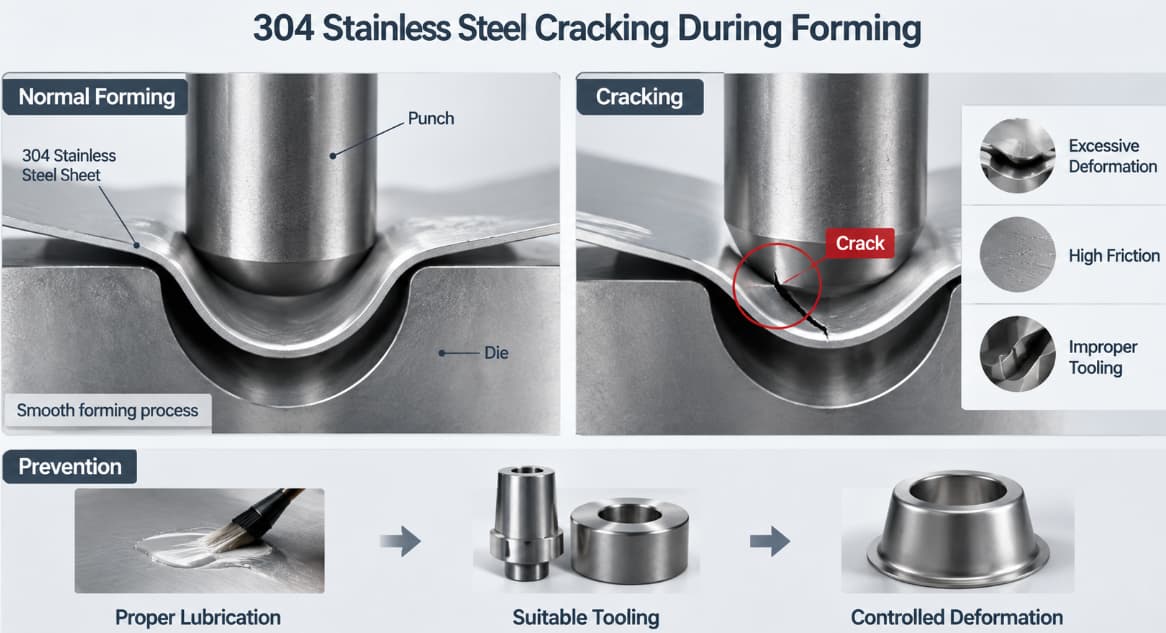
Apply a lubricant suited to the severity of the forming operation, such as a drawing compound or a dry film for heavy deformation. A consistent lubricant film lets the material flow against the die instead of dragging across it.
Apply a lubricant suited to the severity of the forming operation, such as a drawing compound or a dry film for heavy deformation. A consistent lubricant film lets the material flow against the die instead of dragging across it.
Die and punch design, radius, clearance and surface finish, should match the part geometry and material thickness. Tooling that isn't matched to the part tends to concentrate deformation at one spot rather than spreading it across the surface.
Keep each forming pass within the material's safe deformation range. Parts that need a large shape change should go through multiple passes instead of one aggressive pass; a common source of splitting is trying to get there in a single step.
Run the forming operation at a speed that gives the material time to deform uniformly. Speed that's set too high for the process doesn't allow stress to distribute evenly through the part before the tooling has finished its stroke.
Deburr and smooth blank edges before forming to remove sharp transitions and micro-notches. This is a quick check but an easy one to skip, and it's often where an otherwise well-controlled forming job still ends up cracking.
Inspect incoming material for surface defects, inclusions and thickness variation before it goes into production. On our line this inspection happens under the same quality assurance process used for other product checks, using the lab equipment we run in-house.
Die clearance should match the material thickness and forming method being used. Clearance set too tight or too loose forces the material to deform unevenly across the part rather than uniformly.
Before starting a forming run, we check:
None of these seven factors causes cracking on its own most of the time; it's usually a combination, such as slightly high friction plus a sharp edge, that pushes a part over the edge. Working through lubrication, tooling, deformation limits, speed, edges, material quality and clearance as a set, rather than fixing one and assuming the job is done, is what actually keeps 304 stainless steel cracking under control on a production line.
Related articles:
