


Steel pipes are widely used in construction, manufacturing, and industrial projects, with galvanized steel pipe and seamless steel pipe among the most common options. Although they are often compared, they are classified in different ways. A seamless steel pipe is defined by its manufacturing process, while galvanized steel pipe refers to a pipe protected with a zinc coating. Understanding this distinction helps buyers choose the right pipe for different working conditions.
When comparing galvanized pipe vs seamless pipe, neither is universally better. Galvanized steel pipe is preferred where corrosion resistance and lower cost are priorities, while seamless steel pipe is the better choice for high-pressure, high-temperature, and heavy-duty applications because of its superior strength. The best option depends on the service environment, operating conditions, and project requirements.
|
Feature |
Galvanized Steel Pipe |
Seamless Steel Pipe |
|
Definition |
A surface treatment (zinc coating) |
A manufacturing process (no weld seam) |
|
Manufacturing |
Welded or seamless pipe with a galvanized coating |
Produced from solid steel billets through piercing and rolling |
|
Corrosion Resistance |
Excellent((governed by coating weight, per ASTM A123/A153)) |
Depends on base metal only; needs separate anti-corrosion treatment |
|
Strength |
Low to medium |
High |
|
Pressure Rating |
Suitable for low to medium pressure |
Suitable for high-pressure applications |
|
Governing Standards |
ASTM A123 (hot-dip coating), ASTM A153 |
ASTM A106, API 5L |
|
Temperature Resistance |
Moderate |
Excellent |
|
Typical Applications |
Water supply, fencing, scaffolding, outdoor structures |
Oil & gas, boilers, pressure vessels, mechanical engineering |
|
Initial Cost |
Lower |
Higher |
|
Best Choice For |
Corrosive outdoor environments and cost-sensitive projects |
High-pressure, high-temperature, and demanding industrial service |
The two pipe types start from opposite ends of the production line. Galvanized steel pipe begins as an ordinary welded or seamless pipe, onto which a zinc layer is added afterward, through either hot-dip galvanizing or electro-galvanizing. Hot-dip galvanizing is a high-temperature fusion bonding process, per ASTM A123 typically applying a minimum coating weight in the range of 500-600 g/m² depending on base metal thickness, resulting in a thick, metallurgically bonded zinc layer. Electro-galvanizing, by contrast, is a low-temperature electroplating process that produces a much thinner, only mechanically adhered zinc layer — cheaper to produce, but less durable.
Seamless steel pipe, on the other hand, is not a coating step at all but a different way of forming the pipe body itself: a solid steel billet is heated, pierced, then hot- or cold-rolled into a hollow tube, with no welding involved anywhere in the process. That single difference — no weld seam — is why seamless pipe has no heat-affected zone (HAZ), the region next to a weld where grain structure coarsens and local strength can drop. This is the main mechanical reason seamless pipe tolerates higher pressure and cyclic loading than welded pipe of the same grade, and it's also why the process is more expensive: tighter control of dimensional precision and mechanical properties is required than simply coating an already-finished pipe.
Because the two pipe types are built differently, they excel at different things — and it's worth being precise about which property comes from which feature. Galvanized steel pipe's main advantage is corrosion and rust prevention: the zinc layer isolates the steel from air and moisture, and hot-dip coatings hold up better at elevated temperatures than electro-galvanized ones, which are prone to zinc loss due to weaker adhesion. What galvanizing does not do, however, is add pressure capacity — the pipe's mechanical strength and pressure rating are still Governed by its base pipe (welded or seamless), not by the zinc coating itself.
Seamless steel pipe sits on the opposite side of that divide: its main advantages are high overall strength and excellent tensile and yield strength, letting it withstand high pressure, high temperature, and alternating loads, and it's available in a wide range of materials including carbon steel and alloy steel for complex working conditions. But seamless forming provides no corrosion protection on its own — a bare seamless pipe rusts just as readily as a bare welded pipe, and still needs coating, galvanizing, or cathodic protection if it's going into a corrosive environment. Corrosion resistance and pressure capacity are, in other words, two independent properties that happen to be sold as a package in each product — not two sides of the same coin.
When comparing galvanized pipe vs seamless pipe cost, the two differ not just in upfront price but in long-term maintenance costs as well. Galvanized steel pipe has the lower initial cost of the two, though hot-dip galvanized pipe itself runs roughly 30-50% more expensive than electro-galvanized pipe of the same size, reflecting the extra zinc consumed and the higher-temperature process. In return, ASTM A123 coating-weight classes typically translate to a service life in the range of 5-15+ years in outdoor atmospheric exposure (shorter in coastal/industrial environments, longer in dry inland ones), while electro-galvanized coatings, being thinner and only mechanically adhered, often need re-galvanizing within 1-2 years in similar conditions — so its lower unit price can be offset by higher long-term maintenance cost.
Seamless steel pipe carries a higher initial cost, driven by its more complex manufacturing process and wider range of materials. Because it lacks a built-in corrosion barrier, its lifetime maintenance cost depends on whatever external coating is applied — but in high-pressure or high-temperature service this is usually unavoidable regardless of pipe type, since standard zinc coatings themselves degrade well below typical seamless-pipe service temperatures. For harsh working conditions, seamless pipe's longer functional service life still makes it the more cost-effective choice over the project lifetime.
Section 2.2 established that pressure capacity and corrosion resistance are two independent variables — one governed by the base pipe (welded vs. seamless), the other by the coating. Real projects fall into place once you plot them against those two variables rather than treating "galvanized" and "seamless" as a single either/or choice.
A typical municipal water-supply retrofit sits in the low-pressure, high-corrosion-exposure quadrant: DN50-DN150 hot-dip galvanized welded pipe is standard for above-ground distribution runs, because the pressure involved (rarely above 1.0-1.6 MPa) is well within a welded pipe's rating, while decades of outdoor weathering make the zinc coating the deciding factor. A petrochemical plant's high-pressure steam line sits at the opposite corner — high pressure, and an operating temperature too high for zinc to survive on regardless: it will spec seamless pipe to ASTM A106 Grade B or API 5L, sized to the pressure and temperature class of that specific line, with galvanizing simply not an option once temperatures exceed the coating's tolerance.
The two variables can also both be high at once, which is where a straightforward either/or answer breaks down: an offshore or coastal high-pressure line needs both the seam-free strength of seamless pipe and corrosion protection, which is why galvanized seamless pipe — combining a seamless base with a hot-dip zinc coating — exists as a distinct product, at a cost premium over either option alone, rather than being a contradiction in terms.
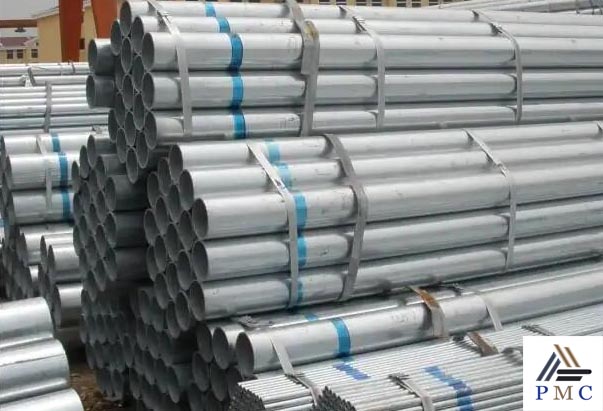
The table below turns the two-variable framework from 2.2 and 2.4 into a direct lookup: find your project's pressure demand and corrosion exposure, and the recommended pipe follows from which variable is driving the requirement — not from the application's name alone.
|
Pressure demand |
Corrosion exposure |
Recommended Pipe |
Why |
|
Low to moderate |
High (outdoor, humid, buried) |
Galvanized Steel Pipe |
Pressure is within a welded pipe's rating; the zinc coating is what actually limits service life. |
|
High |
Low (indoor, dry, controlled) |
Seamless Steel Pipe |
No weld seam is the limiting factor once pressure exceeds welded pipe's rating; coating isn't needed. |
|
High |
High (offshore, coastal, buried) |
Galvanized Seamless Pipe |
Neither variable can be compromised, so both features are required together, at a cost premium. |
|
High temperature (regardless of pressure) |
N/A (zinc breaks down at operating temperature) |
Seamless Steel Pipe |
Zinc coatings degrade well below typical high-temperature service; galvanizing isn't a viable option. |
Q1: How do I verify that a hot-dip galvanized pipe actually meets ASTM A123, rather than just being labeled "galvanized"?
A1: Request a mill test certificate showing coating weight (g/m²) for your thickness class, or spot-check with a magnetic thickness gauge on delivery.
Q2: In coastal or high-humidity environments, how much sooner does galvanized pipe need recoating?
A2: Coating classes are the same nationwide, but salt/pollutants speed up zinc loss — often halving service life versus inland use. Match coating class to site corrosivity (ISO 9223) rather than the standard minimum.
Q3:If I weld galvanized pipe on site, does the joint need special treatment?
A3:Yes. Welding burns off zinc at the joint, exposing bare steel. Clean and recoat with zinc-rich paint, or the weld becomes a common early failure point.
Q4: Can galvanized pipe and bare steel pipe be joined directly?
No. Zinc and bare steel in contact with moisture cause galvanic corrosion. Use a dielectric union or insulating gasket at the joint.
Q5: Does a lower coating class always save money?
A5: Only upfront. In aggressive environments it may need earlier recoating/replacement, and that cost can outweigh the initial savings. Choose class by environmental corrosivity, not unit price.
Related articles:
Installation Steps for Galvanized Seamless Pipe
What Is Galvanized Seamless Steel Pipe?
ERW Pipe VS Seamless Pipe: What's the Difference?
Seamless Pipe vs MS Pipe: Key Differences, Uses & How to Choose
