


304, 304L, and 321 stainless steel are all austenitic stainless steel grades from the 300 series. 304 is the general-purpose grade, suitable for a wide range of industrial applications. 304L is a low-carbon version of 304, better suited to welded applications. 321 is a titanium-stabilized grade, offering improved resistance to sensitization and making it more suitable for elevated-temperature service.
304 Stainless Steel
304 is the general-purpose grade, with medium carbon content typically 0.08% max. 304 stainless steel is a chromium nickel stainless and heat resisting steel, somewhat superior to Type 302 in corrosion resistance.
304L Stainless Steel
304L is the low-carbon version of 304 — "L" stands for low carbon — with carbon reduced to typically 0.035% max. This lower carbon content reduces the risk of sensitization during welding, making 304L better suited for welded structures and pipelines. 304L can also be used for anti-sensitization and intergranular corrosion resistance.
321 Stainless Steel
321 keeps a carbon content similar to 304 but adds titanium stabilization, giving it better resistance to sensitization at high temperatures. 321 stainless steel is known as a stabilized grade of stainless steel — chromium nickel steel containing titanium. It is recommended for parts fabricated by welding which cannot be subsequently annealed, and for parts used at temperatures between 800°F and 1850°F (427 to 816°C), with good resistance to intergranular corrosion.
The titanium element in 321 makes it more resistant to chromium carbide formation. 321 stainless steel has a composition similar to 304, but titanium is added to stabilize the grade and improve its resistance to sensitization at elevated temperatures. 321 also offers better ductility and resistance to stress fracture compared with 304.
|
Property |
304 |
304L |
321 |
|
Grade |
0Cr18Ni9 (0Cr19Ni9) 06Cr19Ni9 S30408 |
00Cr19Ni10, S30403 |
X10CrNiTi189 321, S32100, TP321 SUS321 |
|
Chemical Composition |
C: ≤0.08, Si: ≤1.0, Mn: ≤2.0, Cr: 18.0~20.0, Ni: 8.0~10.5, S: ≤0.03, P: ≤0.035, N≤0.1 |
Same ranges as 304, except C: ≤0.035 |
S: 0.030, Ni: 9.00-12.00, Cr: 17.00-19.00, Ti: 5C-0.70 |
|
Main Feature |
General-purpose grade |
Low-carbon grade |
Titanium-stabilized grade |
|
Welding |
Good |
Excellent |
Good |
|
High-Temperature Service |
Good |
Good |
Better suited |
|
Sensitization Resistance |
Good |
Better after welding |
Good, due to titanium stabilization |
|
Tensile Strength (MPa) |
520 |
Same as 304 (per ASTM A240) |
≥520 |
|
Conditional Yield Strength (MPa) |
205-210 |
Same as 304 (per ASTM A240) |
≥205 |
|
Elongation (%) |
40% |
Same as 304 (per ASTM A240) |
≥40 |
|
Hardness |
HB187 HRB90 HV200 |
Same as 304 (per ASTM A240) |
≤187HB; ≤90HRB; ≤200HV |
|
Density |
7.93 g/cm3 |
7.93 g/cm3 |
7.93 g/cm3 |
|
Typical Applications |
Tableware, cabinets, indoor pipelines, water heaters, boilers, bathtubs, auto parts, medical appliances, building materials, chemicals, food industry, agriculture, and ship parts |
Welded structures and piping requiring corrosion resistance after welding |
High-temperature piping and equipment for chemical, coal, and petroleum industries |
Theoretical weight (kg) = thickness (mm) × width (m) × length (m) × density value — the same formula applies to 304, 304L, and 321.
As can be seen from the above table, 321 stainless steel is titanium-stabilized, while titanium stabilization is not a defining feature of 304 stainless steel. Titanium helps prevent stainless steel from sensitizing and can improve the high-temperature service life of the material. For applications where titanium stabilization is not required, 304 stainless steel plate remains a suitable, cost-effective choice.
The appearance and physical properties of 304 and 321 stainless steel are very similar, except for the slight difference in chemical composition:
1. 321 stainless steel requires trace amounts of titanium (Ti) (according to the ASTM A182-2008 standard, the Ti content should not be less than 5 times the carbon (C) content, but not more than 0.7%, another note, 304 and 321 The carbon (C) content is 0.08%, and 304 does not contain titanium (Ti).
2. the requirements for nickel (Ni) content are slightly different. 304 is between 8% and 11%, while 321 is between 9% and 12%.
3. the requirements for chromium (Cr) content are different. 304 is between 18% and 20%, while 321 is between 17% and 19%. So you can use metal material analyzer or chemical analysis method to verify the composition of these two materials and make judgments.
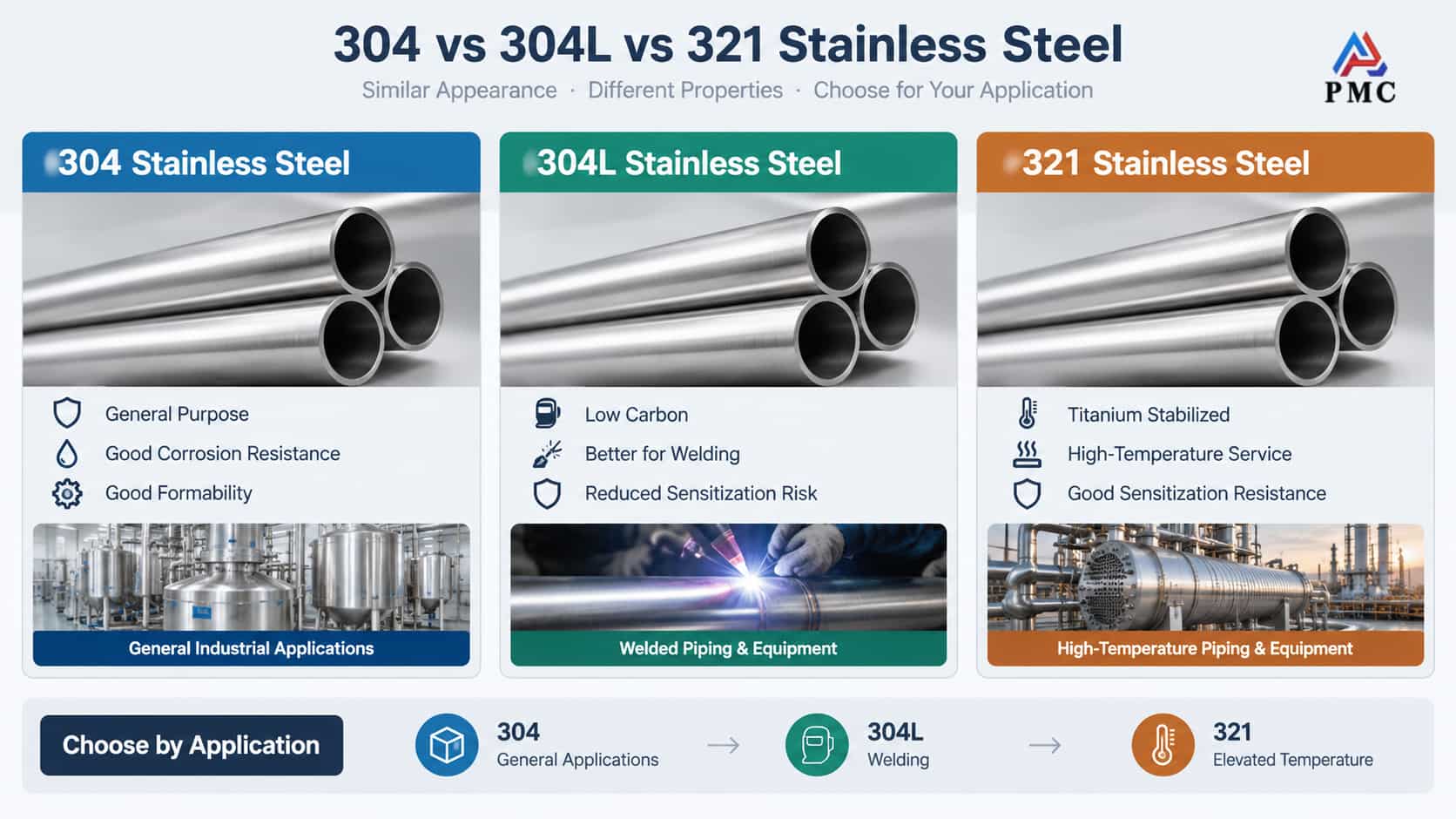
Choose 304 → For general-purpose applications requiring good corrosion resistance and formability.
Choose 304L → When welding is involved or lower carbon content is preferred. For a pipe-specific comparison, see our guide on 304 stainless steel pipe vs 321 stainless steel pipe, Difference between 304 and 201 Stainless Steel Pipes & 410 Stainless Steel VS 304 Stainless Steel, How to Choose?
Choose 321 → For elevated-temperature service or applications where resistance to sensitization is important.
The final choice should consider service temperature, welding requirements, corrosion environment, mechanical requirements, and applicable standards.
304L is not simply "better" than 304 — it has lower carbon content, which reduces the risk of sensitization and corrosion in the weld-affected zone. This makes 304L a better choice for welded fabrications, while 304 remains a cost-effective option where demanding welding requirements aren't a factor.
Neither grade is universally "better." 321 offers improved resistance to sensitization at elevated temperatures thanks to its titanium stabilization, making it well suited for high-temperature service, while 304 remains a strong, cost-effective choice for general-purpose applications that don't require high-temperature performance.
Yes. 321 is titanium-stabilized and is typically recommended for service temperatures between 800°F and 1850°F (427–816°C), where it offers improved resistance to sensitization and intergranular corrosion compared with unstabilized grades such as 304.
Read more:
Should I Choose 304 Or 316 Stainless Steel for Bathroom?
316L Stainless Steel VS 304 Stainless Steel: in Corrosion Resistance
The Difference between Austenitic 304 Stainless Steel and 304 Stainless Steel
Acceptance Criteria for 304 Stainless Steel Pipes
304 Stainless Steel Welded Pipe VS Stainless Steel Seamless Pipe
Food Grade 304 Stainless Steel Pipe vs. Industrial Stainless Steel Pipe
